

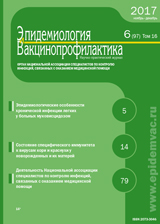
The journal "Epidemiology and Vaccinal Prevention" is a member of Noncommercial partnership "National Association of the Specialists in Control of Health Care-Associated Infections", established with the participation of the All-Russian Scientific and Practical Society of Epidemiologists, Microbiologists and Parasitologists.
The primary focus is contributing to the development of medical science and practice. The target audience is medical society including medical students.
Much attention is commonly paid to topics related to all aspects of immunization and epidemiology of communicable and non-communicable diseases. The number of publications dedicated to general and particular issues of healthcare-associated infections (HAI), HAI terminology and classification, laboratory diagnostics of diseases at medical institutions and HAI prevention has recently increased.
Principal sections: Problem-Solving Article; Original Articles; Anti-Epidemic Practice; Vaccination Practice; Review; Discussion; WHO Information.
The editorial board and editorial council consist of reputable Russian and foreign scientists: 11 Fellows of the Russian Academy of Sciences and foreign academies, 4 Corresponding Members of the Russian Academy of Sciences and foreign academies, and 39 professors.
Scientific articles and reviews are double blind peer reviewed.
Articles are submitted electronically (www.epidemvac.ru) in accordance with article submission requirements. See “Author Guidelines” for correct submission of your article.
The editors of the journal in their work comply with generally accepted ethical standards.
"Epidemiology and Vaccinal Prevention" fully complies with State Commission for Academic Degrees and Titles requirements for scientific journals, and in 2004 was included in the “List of leading peer-reviewed scientific journals and publications in which the main scientific results of the dissertation for the degree of doctor and candidate of science should be published”. In 2015 the journal was included in the current updated list of peer-reviewed scientific publications.
"Epidemiology and Vaccinal Prevention" was registered by the Press Committee of the Russian Federation on 10.10.2000 under No. 011096. In December of 2016 the journal was re-registered by the Federal Service for Supervision of Communications, Information Technology, and Mass Media – Print Media Registration Certificate No. ФС 77-68159 dated December 21, 2016.
International Standard Serial Number (ISSN) – 2073-3046.
The journal is issued quarterly (6 issues per year), volume – 96–112 pages of A4 size.
Subscription is available in the entire territory of the Russian Federation and CIS countries: subscription index in Rospechat catalog – 20140.
In April of 2012 "Epidemiology and Vaccinal Prevention" was included in Ulrich's Periodicals Directory.
In August of 2017 the journal was included in EBSCO
Current issue
ORIGINAL ARTICLES
Relevance. The current global epidemiological situation is characterized by a highly challenging epidemiological situation caused by the combination of emerging biological challenges and persistent traditional threats, necessitating the development and implementation of innovative approaches to epidemiological surveillance and to forecasting the epidemic process of infections caused by known and potential pathogens. Aims. To substantiate a strategy for proactive assessment of epidemiological risks based on genomic epidemiological surveillance in order to improve epidemic prevention and optimize control measures. Conclusion. The modern paradigm of predictive epidemiological analysis relies on integrating pathogen genome data with assessment of its evolutionary potential and the host epigenetic response, which serves as a universal early marker of infection, including infections caused by previously unknown pathogens. Integration of these data with digital platforms enables a systematic, multi-level genomic epidemiological surveillance framework aimed at preventing possible epidemics and pandemics and at developing and optimizing public-health response strategies.
Relevance. An agent-based approach to modeling is widely in demand across a wide range of scientific fields, including research into patterns of the spread of infectious diseases. Objective. To develop a Russian-language adapted version of the ODD protocol to make roprting of results from agent-based modeling more comprihensive and reliable in epidemiological studies. Materials and Methods. We used the authors' original methodological guideline in English, «Overview, Design Concept, Details», or ODD. Our adapted version of the ODD protocol was prepared with the identification of critical user points. The consistency of expert assessments was achieved by calculating the kappa coefficient according to the Fleiss method. All statistical analyses wereperformed in R 4.3.2 (RStudio). Results and Discussion. To the best of our kmowledge, we have first proposed a Russian-language version of ODD. This guidance has been designed to fully describe the process of model development and substantiate the results for use in biomedical research. The article primarily focuses on the "Design Concepts" section. The recommendations outlined therein help justify the construction of a design model and make its presentation less arbitrary and more modern. The Russian version of ODD presents all 11 elements of study design, with a brief description of their purpose and a checklist of topics to consider. The design elements include teh foloowing: basic principles, emergence of new results, adaptation, objectives, learning, prediction, sensing, interaction of agents, process stochasticity, and observation. We provide a user with the description of both a full and a summarized versions of a report based on the ODD recommendations. As for the summarized version, a reader will be provided with a short text template for manuscript formatting. Conclusion. Using the ODD protocol, researchers will be able to describe the agent-based model in detail as a whole, as well as reflect its essential, most characteristic and most sophisticated characteristics, which are not always easily represented by mathematical equations and flowcharts.
Relevance. Research on the development of new, more advanced vaccines against Covid-19, both based on modern technologies and traditional inactivated ones, remains relevant. In the "48 Central Research Institute" of the Ministry of Defense of the Russian Federation, together with the Yaroslavl Factory of ready-made Dosage Forms of JSC R-Pharm, a cultural (based on Vero (B) cell culture) inactivated with beta-propiolactone chromatographically purified vaccine against coronavirus infection Covid-19 was developed. The aim of the work is to evaluate the results of preclinical studies on its immunogenicity and protective effectiveness in animal experiments. Materials and methods. The immunogenicity and protective activity of experimental vaccine samples with adjuvants aluminum hydroxide and CpG 1018 were evaluated, including in comparison with Sputnik V, after double immunization of Syrian hamsters with an interval of 21 days with intranasal infection with the virulent SARS-CoV-2 virus at a dose of 105 Plaqueforming units/individual. In an experiment on monkeys, the effects of the vaccine on double immunization were evaluated: humoral (virus neutralizing antibodies titer) and cellular immunity indicators for 1 year. Results and discussion. The optimal dose of the vaccine was selected – 15 mcg of protein and the composition of the adjuvants included in it was determined: 500 mcg of aluminum hydroxide and 10 mcg of synthetic oligodeoxynucleotide CpG 1018. The inactivated sorbed vaccine against Covid-19 coronavirus infection, when administered twice with an interval of 21 days, induces the formation of viral neutralizing antibodies in 80-100% of Syrian hamsters at titers of 1:20 or more 21 days after the completion of the immunization cycle and is characterized by a lung protection index ≥ 3.2 lg on the 6th day after infection with 105Plaque-forming units of virulent virus (variant “Delta”). The inactivated sorbed vaccine is capable of generating a humoral immune response in rhesus monkeys to both the “Delta” variant and the “Omicron” variant of the SARS-CoV-2 virus. Virus neutralizing antibodies for both variants persists in 100% of vaccinated animals for 180 days after double immunization. By 42 days after the completion of vaccination, there is an increase in cytotoxic T lymphocytes and a decrease in total B lymphocytes. Conclusions. The inactivated sorbed purified vaccine against Covid-19 coronavirus infection, when administered twice, is immunogenic for Syrian hamsters and protects them from intranasal infection with 1•105 Plaqueforming units of virulent virus. The vaccine is capable of generating a specific humoral immune response to both the “Delta” variant and the “Omicron” variant of the SARS-CoV-2 virus. Virus neutralizing antibodies for both variants persists in 100 % of animals for 180 days after double immunization. The effect of immunization on cellular immunity is shown.
Relevance. Rubella virus is commonly associated with a minor infection, however, if transmitted during pregnancy, it can cause serious consequences which includ congenital rubella syndrome (CRS), people with chronic kidney disease (CKD) often have weakened immune systems, making it difficult for them to fight off rubella infection or receive the vaccine. As a result, determining the amount of rubella antibodies in these patients can aid in developing more effective preventative strategies. Aims. The purpose of this study was to assess and compare rubella virus antibody levels (IgM and IgG) in CKD patients and healthy controls. Materials and Methods. A case-control study design was adpted, with 180 CKD patients and 180 apparently healthy persons, serum samples were analyzed for rubella-specific IgM and IgG antibodies by using an enzyme-linked immunosorbent assay (ELISA). Results. Rubella IgM was detected in 81/180 of controls and 65/180 of CKD patients. Rubella IgG was positive in all participants (360/360, 100%). Mean IgG concentration was significantly higher in CKD patients (456.82 ± 144.90 IU/ml) than in controls (169.45 ± 117.52 IU/ml; t = 20.666, p < 0.001). Conclusion. Both CKD patients and controls tested positive for rubella IgG, while CKD patients had a lower IgM positivity rate, patients with chronic renal disease had significantly higher mean IgG titers, which could indicate changed immune regulation or changes in exposure and immunization history. These findings need careful interpretation and additional testing of rubella immunity in patients with chronic kidney disease (CKD).
Relevance. Psychoneuroimmune aspects of the formation of post-vaccination immunity against SARS-CoV-2 are of particular interest for modern virology and epidemiology. The variability of the individual immune response to vaccination may be associated not only with immunological but also with psychophysiological factors. The aim to evaluate the influence of psychophysiological factors (situational and personal anxiety, awareness of vaccination) on the manifestation of the immune response after immunization with a vaccine for the prevention of COVID-19 based on virus-like particles (VLP), as well as to evaluate the relationships between these factors. Materials and methods. A questionnaire was administered to 248 volunteers aged 18 to 60 years to assess sociodemographic characteristics and analyze the level of awareness of vaccination issues. The level of anxiety was determined by the standardized State-Trait Anxiety Inventory (STAI) questionnaire adapted by C.D. Spielberger. The intensity of humoral immunity was also assessed before and after vaccination using enzyme-linked immunosorbent assay. All data were processed in encrypted form using the V1 cryptographic protocol to ensure blinding of the study. The transfer of intermediate data were carried out in accordance with the approved form provided in the clinical trial protocol. The study was conducted with the voluntary informed consent of the patients. The study protocol was approved at a meeting of the Ethics Council of the Department of Regulation of the Circulation of Medicines and Medical Devices of the Ministry of Health of the Russian Federation (№4293530-25-2ЭС-214.08.2025). Results. In the group of volunteers immunized with the VLP vaccine for COVID-19 prevention, there was a significant increase in the antibody titer (p<0.001), along with an increase in the level of situational anxiety (p<0.001). It is noteworthy that an increase in the antibody level by 4 times or more was noted in 90% of volunteers with a low level of state anxiety, while 100% of volunteers with a high level of state anxiety did not have an increase in the antibody titer. Factor analysis identified two components influencing post-vaccination humoral immunity: 1–"Anxiety", which included personal anxiety and state anxiety before and after vaccination (psychophysiological determinants); 2–"Immune-age profile", which included age and antibody titer level at the time of vaccination (biological determinants). The total cumulative contribution of the two components to the total variance was 59.7%. The increase in antibodies had a negative correlation with age and the initial level of antibodies (τ = -0,267; p < 0,00; 95% CI [-0,379; -0,141]; n = 156), while the anxiety level had a negative correlation with the degree of awareness of vaccination (τ = -0,212; p < 0,001; 95% CI [-0,324; -0,095]; n=156). For the first time, a predictive model based on discriminant analysis was obtained. Group membership by anxiety level was used as a classification criterion, and personal anxiety indicators, degree of awareness and age served as predictors. Conclusion. Elevated situational anxiety at the time of vaccination is a risk factor for a diminished post-vaccination humoral immune response. A predictive model has been developed to assess this risk, with patient knowledge being its key modifiable parameter. Targeted enhancement of knowledge about vaccine prophylaxis serves as a practical tool of a personalized approach, aimed at reducing anxiety and increasing vaccination efficacy. Ultimately, this strategy may boost both individual vaccine uptake and the overall public health impact of immunization programs.
PRACTICAL ASPECTS OF EPIDEMIOLOGY AND VACCINE PREVENTION
Relevance. Rotavirus infection remains epidemiologically and economically significant to this day. Aim. To evaluate the preventive effectiveness of the rotavirus vaccine in the vaccination of young children. Materials and methods. This article presents a comparative analysis of rotavirus enteritis incidence across different age groups in the municipal district of «Berezniki City» during the pre-mass vaccination (2010–2018) and mass vaccination (2019–2024) periods. The comparison region was the Kudymkarsky Municipal District, where rotavirus immunization was not implemented. Results and discussion. The findings demonstrate a significant decrease in rotavirus enteritis incidence among residents of the «Berezniki City» municipal district during the mass vaccination period compared to the pre-vaccination era, confirming the high preventive efficacy of rotavirus enteritis immunization. Conclusion. The obtained data support the necessity of introducing mass vaccination against rotavirus infection in first-year infants within specific regions as the most effective tool for reducing morbidity and improving the epidemiological situation.
Relevance. In the context of modern biological risks, the existing system of epidemiological safety of medical activities requires a certain revision and optimization based on innovative approaches to organization and modern technological solutions. Aim. In conditions of high biological risks, using proprietary metrics, evaluate the effectiveness of the proposed system of epidemiological safety of medical activities based on a multimodal approach to its organization. Materials and methods. The epidemiological safety system proposed by the authors was developed in the context of the COVID-19 pandemic and is based on a multimodal approach to its organization, including optimization of personnel, documentation, information, engineering, hygiene, organizational, laboratory and digital support for medical activities and procedures for identification, analysis and risk management in the institution. The effectiveness of the system was assessed on two models of medical organizations using metrics: the risks of infection of employees with SARS-CoV-2 according to PCR studies (n=5216), the level of their commitment to vaccine prevention, the psycho-emotional state of employees (according to pulse surveys of 1024 people) and a comprehensive risk assessment in the institution based on the results of the use of special software a product based on the author's online checklist and its analysis protocols. The study used epidemiological, molecular biological, sociological and statistical research methods. Results and discussion. The effectiveness of the proposed system of epidemiological safety of medical activity is demonstrated. The work of employees in an institution where a multimodal approach was not implemented increased the risk of their infection with SARS-CoV-2 by 1.6 times (OR=1,567, 95 % CI: 1,165-2,108), low adherence to vaccination by 1.5 times (OR = 1,464, 95 % CI: 1,040–2,060), psychoemotional destabilization – 3 times (OR = 3.015, 95 % CI: 2.278–3.991). The use of a special software product showed that in model No. 1, where a multimodal approach was used, the risk of complication of the epidemiological situation both as a whole and when analyzing the results separately for each of the checklist items was acceptable. In model No. 2, the risk of complications of the epidemiological situation was unacceptable for 7 out of 10 assessed sections of the checklist. Conclusion. The improvement of the epidemiological safety system using a multimodal approach has shown its effectiveness according to the assessment of a set of metrics, which must be taken into account when determining the readiness of medical organizations to modern infectious threats and epidemiological challenges.
Relevance. The hepatitis C virus has high genetic variability and is represented by a number of genotypes and subtypes that differ in their geographical distribution. Timely and highly accurate detection of the hepatitis C virus (HCV) followed by genotyping is a prerequisite for starting anti-HCV therapy. The molecular biological method—polymerase chain reaction (PCR)—is currently recognized as the “gold standard” for HCV genotyping. Aim. To study the nucleotide sequences of the NS5B and 5'UTR regions of HCV for the differentiation of subtypes 1a and 1b of genotype 1 (GT), followed by testing of the developed test system based on real-time PCR (RT-PCR). Materials and methods. The study examined 270 blood plasma samples infected with the hepatitis C virus. PCR results were confirmed by comparing the group of samples studied with data obtained using commercially available genotyping PCR kits, which allow differentiation between subtypes 1a and 1b. The specificity of the PCR system was evaluated on 150 hepatitis C virus samples, 100 of which belong to GT 3, and the remaining 50 to GT 2. Results and discussion. Of the 120 blood plasma samples tested, a large percentage of samples were identified as subtype 1b (95 %) and 1a (5 %), which corresponds to the data on the determination of subtypes 1a and 1b using the genotyping kits used in this study. Sequencing of the NS5B and 5'UTR regions also revealed that three samples contained the recombinant form HCV 2k/1b, one of which had previously been identified as GT 2. A specificity test showed that the PCR system under development using the NS5B and 5'UTR regions did not cross-react with 100 GT 3 samples and 49 GT 2 samples. Conclusion. The data obtained confirm the possibility of performing analysis using NS5B/5'UTR regions and the effectiveness of the method for determining subtypes 1a and 1b of hepatitis C virus genotype 1 in clinical practice. In addition, the use of the proposed PCR system made it possible to identify the recombinant variant HCV 2k/1b.
REVIEW
Relevance. As a result of more than 90% coverage of the population with tetanus immunization in Russia, the incidence of this disease has decreased almost 100 times compared to the pre-vaccination period. Nevertheless, over the past decade, 8-19 cases of post-traumatic tetanus have been registered annually in the country, 71.3% of which were among adults. Hundreds of thousands of patients receive emergency immunization annually, in accordance with manual of the last century. The aim of the study. To present the existing problematic aspects of organizing emergency tetanus prevention in adults. Discussion: The main problem of this work is the difficulty or impossibility of obtaining reliable information about the vaccination history of a patient seeking trauma care, which leads to the administration of a double dose of AT-toxoid and antitetanus serum to individuals with a high level of antitoxic immunity. This not only leads to unnecessary financial costs for healthcare organizations, but also to overimmunization of patients and an increased risk of serious adverse events after immunization. The emergency immunization regimen using AT-toxoid complicates diphtheria vaccination planning and conflicts with the instructions for use of the rabies vaccine in cases of animal bites. The indirect hemagglutination test are used for assessing immunity to tetanus in our country, while in other countries, enzymelinked immunosorbent assays and immunochromatographic tests are used for this purpose, including the rapid tests in individual packages. Conclusion. In modern conditions, it is necessary to optimize the tactics of emergency tetanus prevention, including a revision of current recommendations for emergency tetanus prevention, measures aimed at ensuring the availability of data on previously administered vaccinations for patients and healthcare organizations, and the development of domestic rapid tests for the quantitative determination of IgG to tetanus toxoid.
Relevance. Group of immunocompromised patients is large and diverse and has high risk of infection and severe outcomes. Despite evidence that vaccination is effective and safe for this group, official Russian clinical guidelines remain limited in their recommendations. This circumstance poses a risk to the lives and health of immunocompromised individuals. Aim. To analyze whether Russian clinical guidelines and other official documents include recommendations for the vaccination of immunocompromised patients and to assess how detailed they are. Materials and methods. We analyzed Russian clinical guidelines for specific infectious diseases and conditions that may potentially be accompanied by immunosuppression available on the online platform «Rubricator of Clinical Guidelines of Russian Federation» and other official documents. We assessed whether they include recommendations on vaccination for immunocompromised individuals and evaluated the level of detail of these recommendations. Results. Recommendations for the vaccination of immunocompromised individuals are not included in 11 of the 19 (57,9 %) reviewed clinical guidelines for the management of patients with conditions that may potentially be accompanied by immunosuppression (including «Breast cancer», «Chronic kidney disease» and «Living kidney donation»), and in 3 of the 13 (23,1 %) reviewed clinical guidelines for specific infectious diseases (including «Viral Pneumonia», «Community-acquired pneumonia in children» and «Acute bronchiolitis»). There are also no specific guidelines on the vaccination of immunocompromised patients in the Russian National Immunization Schedule. Many of the clinical guidelines that recommend vaccination provide only general recommendations and do not specify the vaccination schedules or vaccine types. Conclusion. The reviewed clinical guidelines contain gaps in recommendations for the vaccination of immunocompromised patients. When vaccination is mentioned, the recommendations are usually incomplete and lack details regarding vaccine types and immunization schedules. Incorporating evidence-based vaccine recommendations into clinical guidelines may help raise awareness among healthcare professionals about the importance of vaccinating immunocompromised individuals, increase vaccination coverage, and reduce the risk of infectious diseases and their consequences in this vulnerable population.
Relevance. Mitis Group Streptococci (SMG), which belong to one of the 5 groups of greening streptococci, are a component of the normal human nasopharyngeal flora and include 17 known species. Among SMG, Streptococcus pneumoniae is the most common cause of a number of invasive and non-invasive human diseases that lead to high mortality rates worldwide. It is interesting to note that a number of studies have shown not only differences, but also similarities in the genes encoding the pathogenicity factors of S. pneumoniae and other members of the SMG, particularly Streptococcus oralis. Aims. To analyze and summarize the results of molecular genetic studies of the SMG and identify the features of the genetic diversity of the pathogen strains. Conclusion. The comparative analysis of the genomes of closely related SMG species revealed key common genes encoding the main pathogenicity factors, which allows for the optimization of the selection of candidate strains for development.
Relevance. Targeted sequencing is becoming an increasingly important tool in the diagnosis of infectious diseases in response to the limitations of conventional diagnostic methods and the high cost and complexity of metagenomic sequencing. Aims. To summarize current approaches for targeted next-generation sequencing (tNGS) in infectious disease diagnostics, to highlight its advantages and limitations in comparison with culture-based and PCR-based methods as well as metagenomic sequencing, and to discuss prospects for its implementation in routine clinical practice and genomic surveillance systems. Conclusion. Targeted sequencing has been shown to substantially improve the sensitivity and specificity of pathogen detection while maintaining turnaround time and cost comparable to conventional diagnostic methods. In addition, it enables accurate pathogen typing and the simultaneous generation of data suitable for genomic surveillance and antimicrobial resistance monitoring. Key technological and organizational barriers are discussed, along with future directions in the development of targeted panels and bioinformatic solutions that may establish tNGS as one of the core tools of infectious disease diagnostics in the coming years.
NASC Information
ANNIVERSARY

ISSN 2619-0494 (Online)





